I use computational analysis to integrate data across experimental modalities, then investigate the resulting questions with molecular and cellular experiments. My work has examined HSP90 biology and treatment resistance in cancer cells, inflammatory responses in microglia, and purine metabolism in pediatric brain tumors. The studies and publications below distinguish published studies from accepted manuscripts, preprints, and work in preparation.
Selected studies
Examples spanning treatment resistance, proteostasis, disease metabolism, and microRNA prediction.
Manuscript in preparation · 2026
From RNA-seq to mature microRNAs
Can gene-expression profiles help estimate mature microRNA abundance when small-RNA measurements are unavailable?
I compared gene inputs, regression and neural models, and biological context using matched gene-expression and small-RNA profiles. The released browser app applies the separately fitted P1 model to estimate 465 mature microRNAs from RNA-seq. These estimates support hypothesis generation and do not replace direct mature-miRNA measurements. The manuscript is in preparation; a preprint is not yet available.
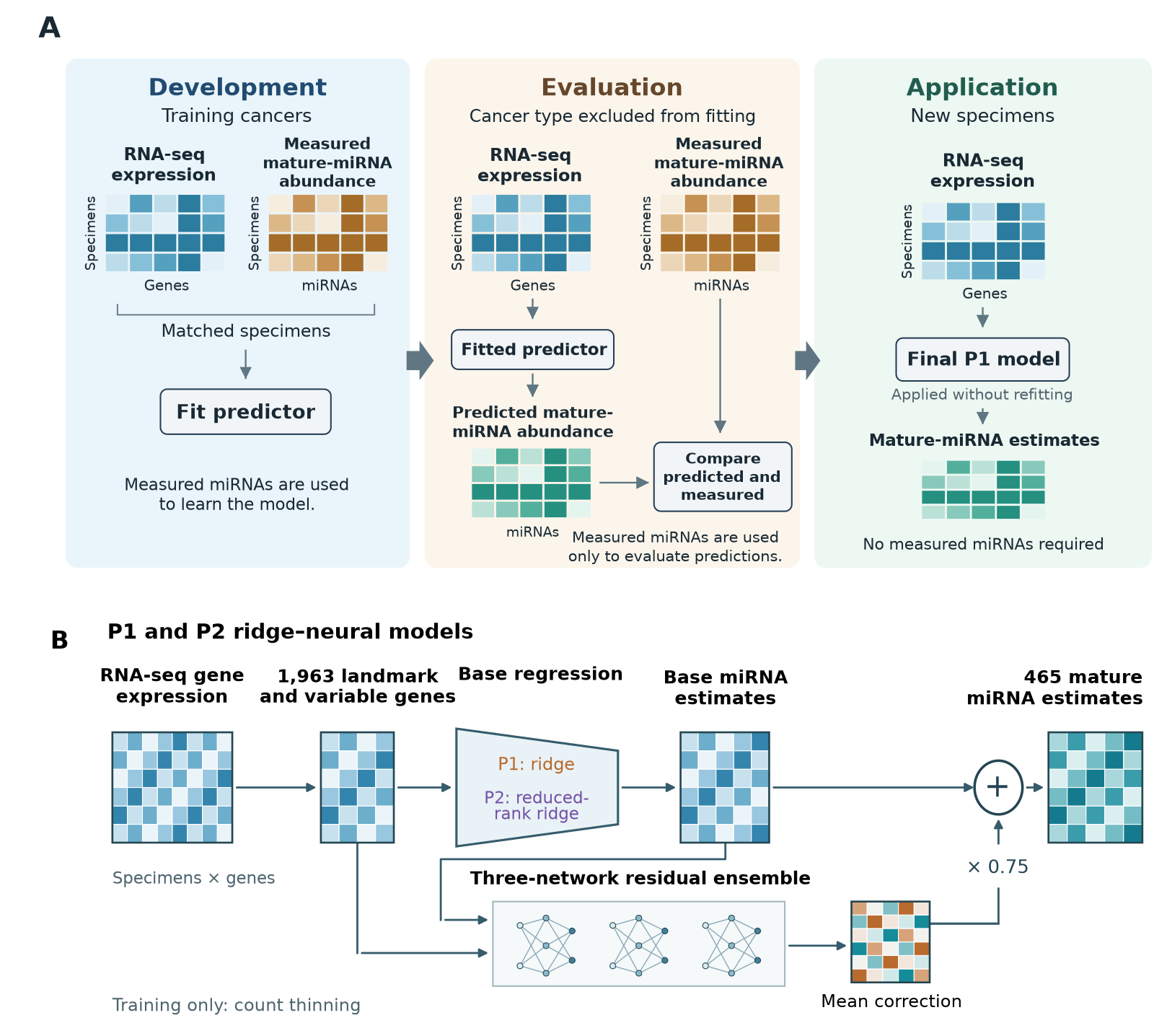
Paired RNA-seq and mature-miRNA measurements support model development and evaluation; the final P1 model estimates mature-miRNA abundance from RNA-seq alone. Manuscript in preparation. Ian Mersich, CC BY 4.0.
For cancer-exclusion evaluation, the model is fitted without specimens from the evaluated cancer type. The final P1 model is fitted separately on all 10,944 TCGA development specimens and applied without refitting. P1 and P2 each have their own regression fit and three-network correction ensemble. The mean correction is multiplied by 0.75; 458 outputs are corrected and seven retain their base predictions. Estimates are not clipped. Count thinning is used during training only; the matrices are schematic.
2026 · iScience
Reprogramming broad drug resistance
Can shared molecular features of broadly drug-resistant cancer cells identify compounds that improve treatment response?
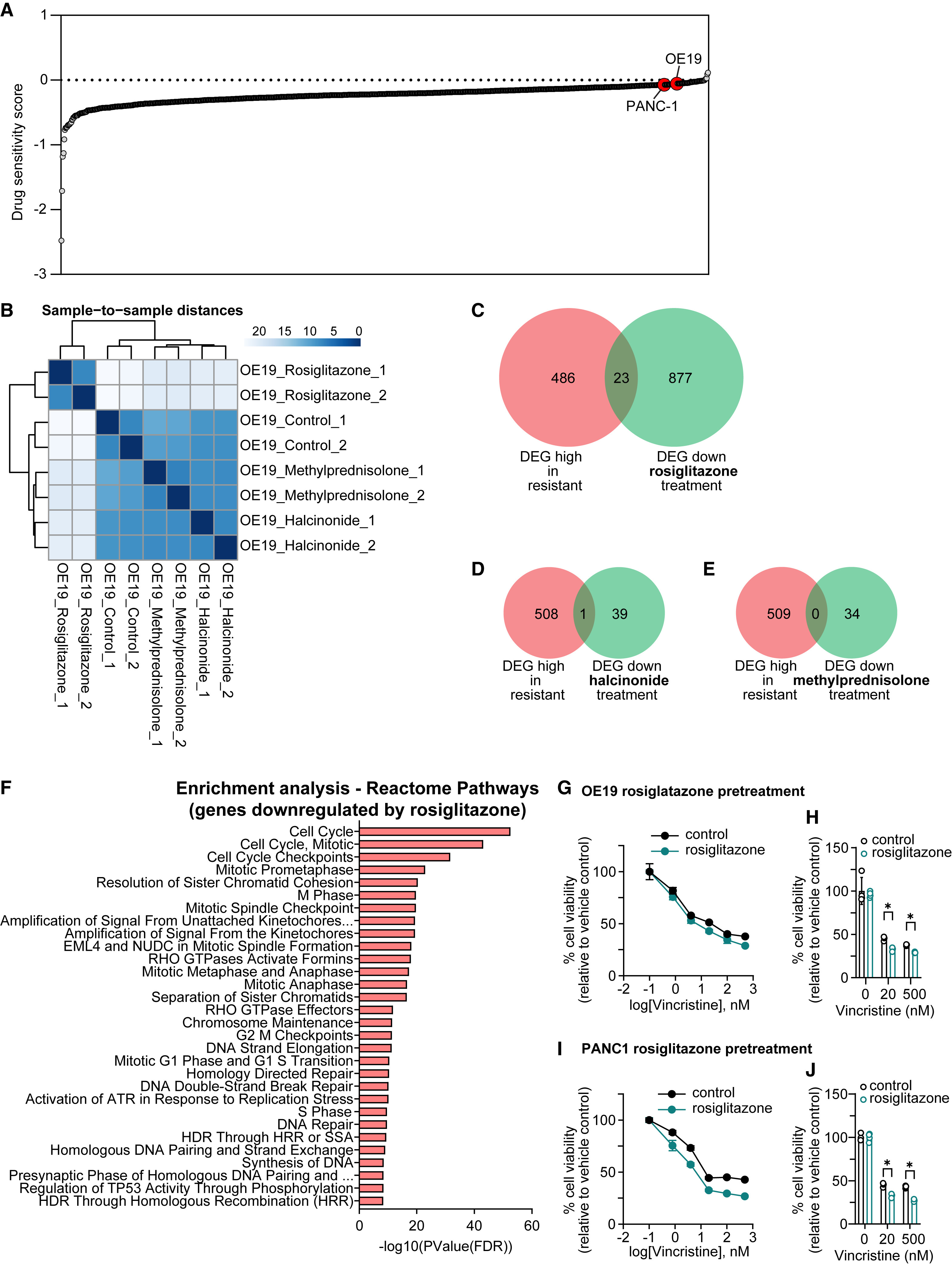
I integrated PRISM drug responses with transcriptomic, mutation and metabolomic profiles, then used gene-expression perturbation resources to prioritize compounds predicted to counter resistance-associated programs. Experimental follow-up linked rosiglitazone to changes in those programs and increased vincristine sensitivity. The effects remain specific to the tested cell models and conditions.
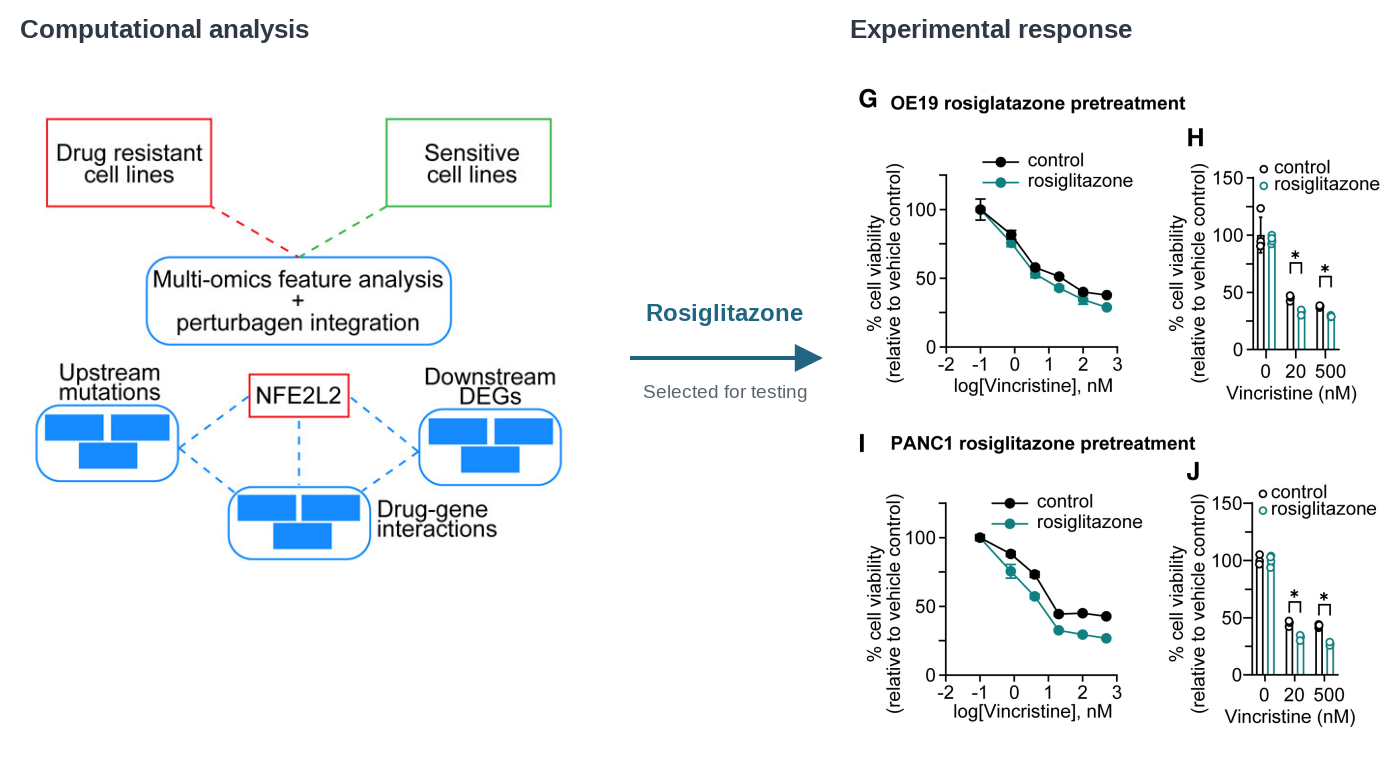
Multi-omic comparisons connect rosiglitazone selection to measured vincristine responses in OE19 and PANC-1 cells. Plots show mean ± SD from four biological replicates. Mersich, Blagg and Ali, iScience (2026), CC BY 4.0.
OE19 and PANC-1 cells received 1 μM rosiglitazone for 24 h before 72 h vincristine exposure. The computational artwork and Figure 6G–J are reproduced from the paper; source artwork is unchanged within the selected regions and the abstract’s schematic heatmap is omitted. View complete published Figure 6.
2025 · Cancers
Adaptation to HSP90β inhibition
Cell models resistant to selective HSP90β inhibition showed changes in cytoskeletal, metabolic, and stress-response programs. We tested a combination with carboplatin that showed synergy in the resistant models.
In H3K27M-mutant disease models, we linked Nuclear Factor I activity to altered purine metabolism. Targeting ATIC reduced tumor progression and improved survival in mice. The journal article is accepted; the link opens the earlier preprint.
Serwetnyk MA, Tanguturi P, D'Amico T, Morishima Y, Lau M, Mersich I, Barlow D, Houseknecht KL, Osawa Y, Streicher JM, Ali A, Blagg BSJ. Journal of Medicinal Chemistry. Published online October 8, 2026.
Mersich I, Congrove S, Horchar M, et al. Accepted August 18, 2026; final journal citation pending. Link opens the earlier bioRxiv preprint under a different title.